Guide A1 Independent notes
Net art history: from the early web to post-internet art
Net art is art made for the network, where the browser, the link and the page are the material. Its history is short, fast and unusually fragile.
What is net art?
Net art, also called internet art, is art that is made for the internet and often cannot exist without it. The work may be a web page, an email exchange, a piece of software that runs in the browser or a project that plays with how people use online services. The key point is that the network is not only the place where the work is shown. It is part of what the work is made of.
That is different from a photograph of a painting posted online. Museum guides such as the Tate explainer on internet art and the Whitney's artport portal treat the field as a form with its own history, vocabulary and conservation problems.
The early web as a new medium
Public use of the web grew in the first half of the 1990s, after graphical browsers made it possible to click through pages instead of typing commands. Artists noticed quickly. A web page could be edited, copied and viewed on any computer, and it could be seen without a gallery, a catalogue or a plane ticket.
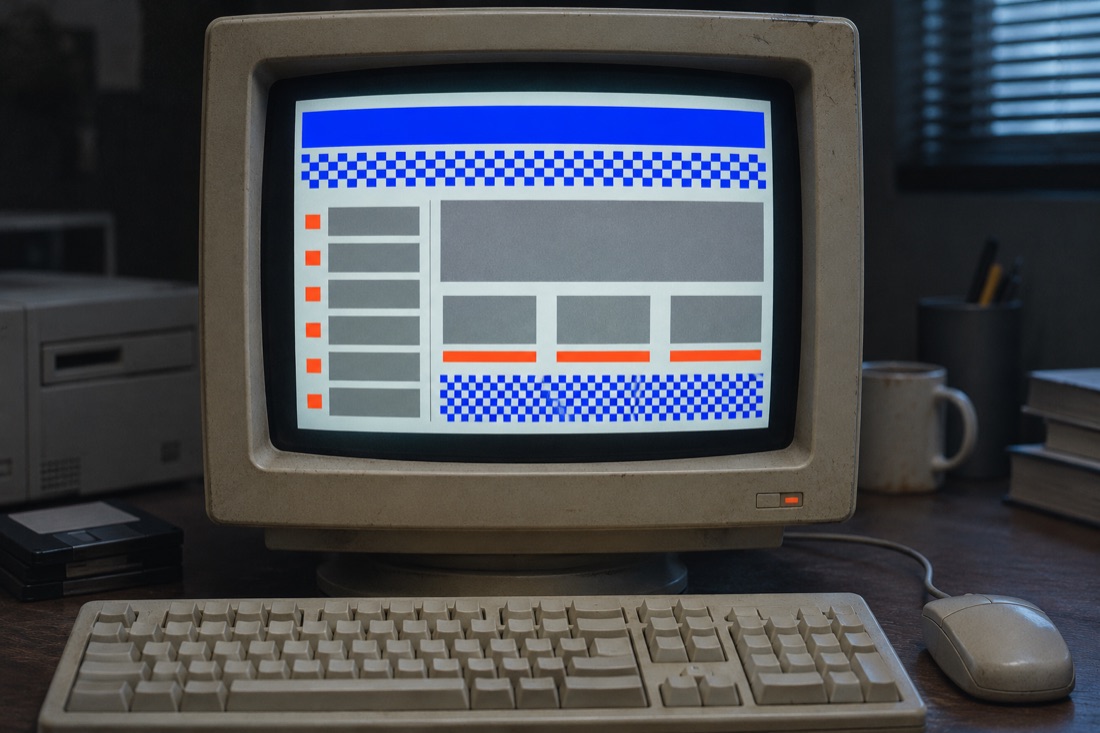
Many of the first net artworks played openly with the look of the web itself: plain backgrounds, default fonts, broken layouts and the behaviour of links. The duo JODI, with web work from the mid 1990s, and Olia Lialina, whose 1996 piece My Boyfriend Came Back from the War used frames and hyperlinks to tell a story, are often named in histories of the period.
The net art movement and its platforms
In the mid 1990s small, loosely connected groups of artists, writers and programmers shared work through mailing lists and websites. Accounts of the net art movement often describe this as a conversation rather than a school with a manifesto, and the origin of the label net.art is told in several versions. Treat any single neat story with some care.
Platforms mattered. Rhizome, an online community that started in 1996 and later became affiliated with the New Museum in New York, built a long term archive of born-digital art. Museums followed in the early 2000s with online programmes and commissions for the web.
After net art: post-internet art
As social platforms, search engines and smartphones became part of daily life, artists shifted from the browser as an experimental space to the whole online culture around it. The term post-internet art is used for work made after the internet became ordinary, and it can show up as sculpture, print or video as well as screen work. The term is contested, so look at how a given writer defines it.
Related terms you will meet include web art, software art, browser art and net.art with a dot. They overlap, and artists often reject the labels. A useful habit is to ask what the work needs from the network to function.
Why net art is hard to preserve
A web artwork depends on servers, browsers, plug-ins and other websites. When one of those changes, the work can stop working without anyone touching it. Adobe ended support for the Flash Player at the end of 2020, and major browsers removed it, so a whole generation of interactive pieces suddenly needed a new way to run.
Responses include web archiving tools that capture a site as it behaved, emulators that run old software in a modern browser, and restoration projects such as Rhizome's Net Art Anthology, which brought influential works back into view with documentation. We look at the practical side in our guide to collecting and preserving new media art.
Where to see net art today
Start with institutional sites: the online collections and commissioned projects of museums, plus archives such as Rhizome's ArtBase. Many works are free to open. Some run only in an emulated environment, and some are documented through video and text because the original no longer works. Read the notes next to a work to see which version you are looking at.
For physical visits, see our overview of new media art museums. For the broader field, return to the main guide to new media art.